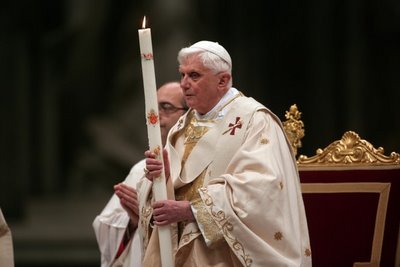
I am...uh...'borrowing' this beautiful picture from Dr Taylor Marshall's blog Canterbury Tales to talk about the Divine Office today. This post was particularly inspired by the blog Medical Matins, which is a must read for all Medics! For all my busy Medic friends, I have written this post, especially with you in mind. I hope you will at least read through most of it!
I love the Divine Office, after Mass, it is the next thing that keeps me sane every day. Daily Mass thought me how to centre my life around Christ. Because of the fixed time of Mass, it really requires to plan your day around it, in a sense it becomes the centre of your life. Going to meet friends in town? Mass is at half past six, either meet before or after Mass. The Divine Office pushed that to a new level for me. They say you get the most graces when you say the hours in the times when they are supposed to be said (Thankfully, you can anticipate matins!). Thus, when you completely settle the entire day around praying, it is really special.

I cannot explain it, but you really get a lot of graces from praying the Office. For those who are unfamiliar with the Office, it is essential praying the entire set of Psalms. In the extraordinary form of the office (EF), you pray all 150 in a week, in the ordinary form of the office (OF), you pray 143 psalms across the span of a month. As you all know, I am your typical Catholic, I have never read the bible from cover to cover, and I would have never dreamed of reading all the psalms, let me repeat, all the ONE HUNDRED AND FIFTY psalms. Yea, well, only through the grace of almighty God, I read it and continue to so every week.
And not only that, Matins, which consists of 9 psalms arranged into three nocturnes with accompanying lessons means that if God willingly, this time time next year, I'd have read through most of the bible as well! Well, not in it's entirety, as they do skip verses, but it's amazing! Right now, I am reading through the soap opera of King David's life in the second book of Samuel. He's just done nasty things with Bethsheba and Prophet Nathan is banging on his door. You'll have to read the rest yourself, it's all very fiesty ;)
Back to the point, you really do get a lot of graces. God likes to give out graces to people who want to pray more. Having difficulty with your daily prayer, like me? He will shower you with strength. It seems long, but each just Office just flies by. Not to mention how much it keeps temptation at bay.

For the Medic on the go, especially clinicals or doctors working, especially those who can't get to daily Mass, or find it hard to seek prayer during the day, or if you just need an escape into God's wonderful arms, the Office is the way to go. The various hours of the day punctuate the time, and will give you the strength to go on. Not to mention, the little hours are short, about 5 mins a piece. You can sneak them into your day at appropriate intervals. They are a booster of grace, if you will.
I said the Office only in the second semester of school, and it helped me to carry on during the long hours of study. You have no idea how many times through the day, when one stumbles upon an encouraging line, like psalm 56, 'Have mercy on me O God, have mercy on me, for upon You my soul has relied, /And in the shadow of Your wings I will trust, until the wickness passes by.' Not to mention all the lovely psalms of praise, like psalm 116, 'Praise the Lord all ye nations, etc'. Even if you can only find time to say compline, you will benefit greatly!
While it is only a devotion for us, the Divine Office is an obligation for all priests, and it sustains them. Here's a remark from a damned priest on the power of the divine office:
As far as I was concerned, I used to remember that I was a priest and, at the beginning, I used to exercise my Priesthood responsibly. And then, as time went by, I found that monotonous and, forgetting prayer, I also forgot about celibacy. I cut out prayer, firstly because I believed I was too busy, and then I used to take it up again occasionally, and then, finally, I abandoned it altogether. I used to think that those long prayers in the breviary were tedious and useless and, in the end, I lost the taste for prayer.
When I cut out the breviary, I fell into the sin of impurity, and from that moment on, I had no more taste for saying the Mass. This was a chain reaction. When I fell into impurity this was the chain reaction - I no longer said the Mass devoutly because I was no longer in the state of grace. In this condition, the reading of the Bible and of the Gospel, in particular, and also the sight of God's commandments, became a reproach to me.
The above from the a transcript of the damned priest, Verdi-Garandieu, whom God allowed to speak during an exorcism to a give a warning of damnation. So, it's got a stamp of approval from a damned soul. I suppose that's not much in terms of accreditation, but the Saints also have much to say as well. See St Alphonsus of Liguori:
On the other hand, when one recites the Office with attention, what merit and what profit does one derive from it. What lights are then obtained from the divine words! With what holy maxims is the soul penetrated! How many acts of love, of confidence, of humility, of contrition, may one not make by merely paying attention to the verses that one recites! Above all, what beautiful prayers are found in each psalm! There is no doubt that, when recited with faith and fervor, they merit treasures of grace, according to the infallible promise made by our Lord that he would hear whoever prays to him : Ask, and it shall be given you.(Matt. 8:7) For every one that asketh, receiveth.(Luke 9:10)
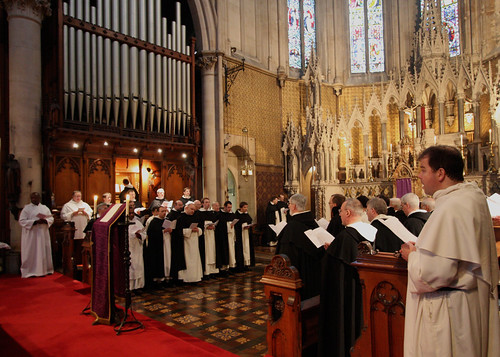
I first got started in the Office way back in 2009 when I bought an anglican breviary it was a translation of the 1955 Roman Breviary, so it was the EF office. During those days of tepid faith, I started clumsily with Compline. I loved it, especially the hymn, Te Lucis Ante Terminum, but unfortunately, a lack of mental stamina prevented me from overcoming the ribbon flipping and mountain of instructions. After a while, the saying of compline dropped out of my prayer routine.
It was only this year actually, after finding out all my friends were actually saying the office and so I thought, you know I'd better succumb to peer pressure like a good peer-pressure succumbing youth and jump on the bandwagon. I had, for sometime now, an app on my Ipod Touch, called Breviarum Meum, which allowed you to download the text of the EF Office into your phone for the week, which had both the Office in Latin and English.
See the none of this would have happened if I hadn't gotten into the habit of sleeping early and waking up at 3am to study. I just get more work done in the morning before heading off for morning Mass. I used to joke that me getting up so early was practice for saying Matins, which are usually sung at 4am in monastic communities. Unfortunately, God took too me seriously. I had originally started with Lauds, Vespers and Compline, each about 12 mins, and then I eventually, I felt that I had to add the little hours, Prime, Terce, Sext and None. The little hours are actually very short, and take about 5 mins each, with the exception of Prime (8 mins).

Before I knew it, I was toying with the idea of Matins...and BLAM! I'm waking up daily at 3am saying Matins every day at 4. And I loved it. Matins on normal days takes about 20 minutes to say, and on days with 3 nocturnes takes about 35 minutes. See what happens when you even joke about praying more?
All in all, if you're trying to squeeze in an hour of prayer a day, the Office is the way to go. It comes in delightful bite sized pieces. The aforementioned Dr Marshall has a really lovely piece on praying the Office. Read it here: http://cantuar.blogspot.sg/2010/12/how-to-pray-divine-office-in-latin.html. It is by far, the best article I have read on it yet.
I've also never actually said the Office in the OF, also called the Liturgy of the Hours, before. I started with EF by coincidence and have just start with it. If you want to know more about the differences between the two, read the comments in the above link on Dr Marshall's blog. All I can say, having looked at the OF Office, is that is is a kind of Divine Office lite, though they have more readings of the church Fathers. Try out the online versions and see which one you like.
Anyway, don't let all this waking at 4am be an obstacle to your recitation of the office. I am a weird person after all. Now, that I am on holiday and am no longer waking up at 4am to pray Matins (which I miss doing), but I just start praying the Office in chronological order whenever I get up, which is between 10 and 1. I am a slob, I know. I also used to be very scrupulous about not missing an hour within the proper time frame, it was a great fear actually. Thankfully, after chillin' with some deacons from the Fraternity, they taught me that you can just say the hours as time permits within the span of 24 hours. We were touring Dublin on foot, and they pretty much wiped out their breviaries whenever time permitted. Also, remember that as lay people, we are not obliged to say the breviary.
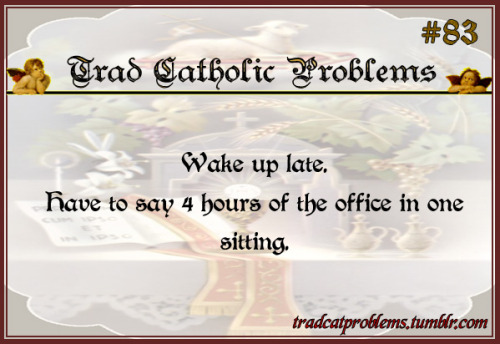 |
| I really hate when that happens, because of my short stamina for prayer. |
Getting Started
My advice is to pray to God and ask Him for the grace to say the office, and then start with Compline. It is the sweetest and easier office to say, because it is nearly the same every day. Then add Lauds and Vespers. Don't worry about saying Lauds before dawn, just try and say it in the morning. Soon you'll be doing that Pringle thing where you can't stop popping and you'll find yourself saying all the little hours. And you know how the story goes from there.
It helps to start with an electronic form of the Office, because it has all the parts laid out for you in the right order. I.E. not ribbon flipping and confusion. Over time as you get used to it, go out and buy a set of Breviaries. The OF Office, also called the Liturgy of the Hours, comes in a 4 Volume set or a 1 Volume book called Christian Prayer. You should be able to get that from your Church bookstore, you can also order them from amazon or www.divineoffice.org, which also has the hours in English daily. That is a useful way to start. If you want it in Latin: http://www.almudi.org/Portals/0/docs/Breviario/fuentes/breviario.html. If you like to try the EF Office, the hours are available online here: www.divinumofficium.com. Unfortunately there is only one Latin-English Breviary available now, and that is by Baronius Press: www.baroniuspress.com. However, that is a rather dear breviary, but it is worth the price for something will last you over a decade and will be used every day.
For iPhone apps (which I think are available on android too):
OF Liturgy of the Hours:
http://www.ibreviary.com/
http://www.ibreviary.com/
EF Divine Office:
All the best, and drop me a note if you have any questions or if all goes well for you!