Somehow, the topic of heroes within society always seems to return to my mind despite long vacations. That shouldn't be much of a surprise I suppose, since virtue ethics is a pet topic of mine. That, and I will give you a earful about why society needs heroes and not role models.
This isn't going to be a long post, just some food for thought really. Heroic virtue is necessary for sanctity, in fact it is something that sanctity exudes, the necessity to go beyond the call of duty, to go beyond what one is capable, constantly pushing oneself in a sacrifice for someone else. I cannot think of a saint who is not a hero in some way or another. In fact, for quite a few of them, their entire lives could very well form the plot of a great comic book. Incidentally, we are all called to be saints. Oh yes, you too. You are meant to be a saint, to be holy. That is, you must become a hero.
So what makes a hero? It's not merely the external acts of valour, bravery and courage that make a hero. It begins from within. It is an interior transformation that must occur, the changing of cowardice to courage, of weakness to tenacity, of tepidity to passion, selfishness to generosity and so on. This takes time and the slow purification and distillation of the virtues within the soul become manifest in the outward actions that we see in real life.
Just think about it. Peter Parker didn't just become Spider-man over night. No, his Uncle Ben and Aunt May, from young, had been teaching him the very necessary virtues to become heroic. It was only the untimely stabbing of his uncle that led sealed in those lessons. Superman was made a hero by his foster parents, likewise Bruce Wayne became Batman because his parents, and later alfred, taught him justice and truth. Likewise, firemen don't dash into blazing buildings without first undergoing months of training; training which is more than just physical and technical but also internal. So to is the saint in the making. His internal change comes from similar means his prayer, penance, fasting and mortification, all which stem from and add fuel to that all consuming fire which is the love he has for God.
The success in virtue is not the only thing which defines a hero, there are also his failures. By now, one must realise that it is impossible to live in the world without falling and failing. This is what happens because of the very simple fact that we are all fallen creatures. That is, no one on this planet is sinless, save two individuals in the past. We live in a world where it is not alright to fail, yet failure is absolutely necessary to growth. We learn best from our mistakes, because successes do not tell us where we can wrong. Morally, of course this mistakes mean the committing of evil actions, however we need them from time to time to learn as well. It is, of course, necessary not to let the mistake define us, but the lesson behind the mistake. Hercules would not be Hercules if he hadn't done the reparation for accidentally slaying his children. Peter Parker wouldn't be Spider-man if he had stopped the thief from getting away. St Augustine wouldn't have become St Augustine if he hadn't fought his lust and won.
That's the lovely thing about being a hero is that heroes are allowed to make mistakes, whereas role models aren't. A role model that doesn't live up to his expectations, fails to fulfill the criteria of the role that he is supposed to be a the model for, thus losing the status. On the other hand, we expect the hero to fall out of his horse from time to time, and then get up and climb back on, this time with renewed resolve to charge at the dragon. Sometimes, he falls, and has to chase his horse, but he eventually gets there and wins, though he never knows if he will.
This actually applies to all aspects of our lives as St Thérèse de Liseux so wisely taught in her little way: to do all the ordinary things extraordinarily. In fact, that is where heroism first manifests itself, in the unseen things, in the things no one notices. When we listen to each patient as if they were the only patient in the world, or just always being on time, or doing each drill as it if it were the exam or game. See, it's never about the quantity of what one does, but the quality one inject into each action. Spider-man would be a hero even if he only saved one person, and only because he put all of himself into saving that one person.
Likewise, this is often where we fail, when we make mistakes. In the little things, and then the little things pile up and drown us. It is a common motif in comic books, where the superhero must juggle his heroism with his personal life. How many times has Spidey missed an important event because he was out saving some part of New York City from destruction courtesy of the Green Goblin? Bruce Wayne is always shown being asleep or uncaring during his business meetings. One of the reasons why Wayne Enterprises collapsed in the movies. Yet, even here, the superheroes apply their heroic skill and courage in starting afresh and reparating for all the hurt they caused. Likewise, when we fall, we have confession, and then once again bathed in the blood of Christ, we come out white as snow, and refreshed and ready to fix whatever harm we've caused.
So, it's actually rather simple to be a hero. We should be heroes, beacons of hope for our children especially, and our family and friends. Start today. It merely begins by loving God with all your heart, and mind and soul, and then to living out his commandments.
PS: Yes, I did promise a short post, but unfortunately brevity is not one of my heroic fortes.
PPS: I wrote this for you, and yes, I think you're a hero already.
EDIT: Thanks to the Anti-Modernist. I left out one very important point. Heroes always strive to do the right thing. They may make mistakes here and there, but they always come through in the end, even making reparation for their mistakes. Think of Boromir in Tolkien's famous epic, the Lord of the Rings. He attempts initially to steal the ring from Frodo, only to end up in sorrow realising his great sin. Well, Boromir doesn't remain there in sorrow, he gets up kicks orc butt saving Merry and Pippin...well until he dies at the hands of the archers. Nevertheless, a hero redeemed.
Monday, August 13, 2012
Friday, August 03, 2012
Our Love For the Church
The Church is the Bride of Christ, she is our Mother; we ought to love her because she brings us to Jesus and unites us to Him. We ought to love and revere her doctrine, because it is doctrine of Jesus Christ; to love her prayer and associate ourselves with it because it is the prayer of the Bride of Christ, and there is none safer for us, none more pleasing to Our Lord.
We ought to attach ourselves to the Church, to all that comes from her, as we should have been attached to the very Person of Jesus and all that came to us from Him, if it had been give us to follow Him during His earthly life.
St Pau compares her to an edifice 'built upon the foundation of the Apostles, Jesus Christ Himself being the chief cornerstone.' (Ipso summa angulari lapide Christo Iesu).
We live in this house of God, '…no more strangers and foreigners: but fellow citizens with the saints…' It is Christ 'in whom all the building, being framed together, groweth up into an holy temple in the Lord.'
- Dom. Columba Marmion, Christ the Life of a Soul
Wednesday, August 01, 2012
Marriage and Vocations Pt 3
Da
Boyz.
The men are not off the hook either. Just
like there is a jarring loss of authentic femininity in women today, there is also an equally
jarring loss of masculinity in men today as well. Heck, in this case, I’m even
willing to go as far as to say it was this loss of authentic masculinity that
resulted in reaction known as the feminist revolution. However, unlike women
who went wayward in a movement aimed at bettering women’s lives, men lost
themselves in a slightly more complicated fashion.
Authentic
Masculinity
To understand the heart of the problem, one
first must understand what the man is supposed to be. The very essence of man
is the need to sacrifice himself for the good of his family. In the bible,
Christ reminds the Pharisees that, in the beginning, ‘a man leave father and
mother, and shall cleave to his wife, and they two shall be in one flesh.’ This
very act of leaving the caregivers of his life to enter into the unknown world
is in itself a sacrifice. From then on, he will put aside his needs and desires
and physically exhaust himself in a job that he may or may not like to bring
home dough for his wife and children. In the past that would mean putting his
body on the line to go hunt, in the modern world, it is sitting at a desk all
day long.
All this can be observed through natural
law. In some tribes there are coming of age rituals, signifying the boy’s
transition from boyhood to manhood. From then on, he is expected to keep the
company of the men, where he learns to be one of them and to hunt and protect
his family. Even biology mimics this, where at the age of 4, the boy must
separate himself from his mother and join to his father, or gender identity
disorder may occur.
It is in this bond that the boy learns how
to carry out his masculine duties through imitation, how to sacrifice himself
and treat every woman as a lady, to put himself second, and give her the first
place.
To draw a parallel, it is this same path
that Christ, Himself, took. He left heaven and took on the form of man, where,
He then went and sacrificed His body through the beatings, scourging, the crown
of thorns, the carrying of the cross, and finally the crucifixion itself in
order to redeem the entire world. It is this external sacrifice that is innate
in masculinity that allows a man to become a priest and to act in persona
Christi, in the person of the most masculine, to offer up the sacrifice of the
most innocent to God the Father.
Hence the occupations that boysmost
identify with often require some form of physical sacrifice. Every boy at one
stage has wanted to be a soldier or a policeman or a fire fighter. To serve and
protect is practically innate within the male. That is why men were given such
great passions and energy, to channel it for the greater good of society. It is
in growing up that we learn to master these passions and to defeat dragons, the
first of which being ourselves. Only when we have the discipline to conquer our
passioned wants and needs will we have the ability to take on other dragons, to
be ready for battle. We were meant to be knights in shining armour. So where
did we go wrong?
Utilitarianism
The fallout of traditional philosophy
during the enlightenment period gave rise to empiricism and skeptism, which led
to the ethics of Utilitarianism. As mentioned in the previous articles,
Utilitarianism can be summed up as ‘whatever means to achieve the greatest
pleasure’. It is a relativistic course of ethics whose moral principles largely
depend on what one can get away with. Hence, the spawning of the ‘me’
generation whose effects can be largely seen in almost every aspect of society.
In economics, duty and honour between employers and employees has since been
thrown out the door, it is how much the employer can milk his employees for
profit. In healthcare, doctors have been relegated to prescription writing,
pill dispensing units thanks to the application of Prinicipalism which has
utilitarian roots. In advertising it has become developed to the point of
whatever sells the product, and of course, that is sex. One hardly comes across
an advertisement nowadays that isn’t sexed up in some way.
When applied to the man, this idea of I’ll
use whomever I want to give me pleasure, has eroded the presence of the truly
masculine in society. Once men were protectors, they have either become
predators, just going around using women for their personal gain or they never
grow up, being stuck in front of the computer screen all day long, indulging in
their fantasies. This uh mascularism, if you will, the corruption of the
masculine with utilitarian principles, is why women who desire to get married
to a good and loving husband will be hard pressed to find one.
Over-sexed
Culture
It doesn’t help that the culture has become
sex-obsessed. The gender-sociologist have turned sexual preference into an
identity, elevating it from an accidental feature of humanity into an essential
feature, and the only essential feature, hence the LGBT movement and this silly
notion that one’s gender is completely a social construct, never mind the
staggering research into the physiological and anatomical differences between
men and women. You can choose whether you want to be a boy or a girl in the
head, but not whether you’re attracted to boys or girls. It’s all rather odd if
you ask me.
What’s more, in today’s culture, boys are
expected by society to watch pornography, masturbate and be promiscuous. This
could not be more contrary to nature! Pornography addiction is particularly
prevalent and its incidence is on the rise. What’s the big deal you ask? Well,
leaving aside the obvious problems for the moment, like that it’s a grave sin, it
denigrates the marital act in its fiction and teaches men to objectify women,
what about the fact that porn stars themselves are horribly damaged and abused
individuals? That’s right, as long as you watch pornography, you are supporting
the abuse of men and women who are completely broken and damaged inside. (see
theporneffect.com)
Masturbation is also a very dangerous
habit. I won’t say much and let C.S Lewis do the talking for me, ‘For me the
real evil of masturbation would be that it takes an appetite which, in lawful
use, leads the individual out of himself to complete (and correct) his own
personality in that of another (and finally in children and even grandchildren)
and turns it back, sends it back into the prison of himself, there to keep a
harem of imaginary brides. And this harem, once admitted, works against his
ever getting out and really uniting with a real woman. For the harem is always
accessible, always subservient, calls for no sacrifices or adjustments, and can
be endowed with erotic and psychological attractions which no real woman can
rival.’
Read more about that here in an article by
Fr John Harvey, OSFS on the Courage website http://couragerc.net/Masturbation.html
I think I don’t need to speak as well about
how sleeping around will mess a man up completely as well.
Chivalry
is Dead
All these grave sins have lead to a huge
rusting of the shining armour that men once proudly wore because the armour of
virtue and chivalry cannot be worn by a man who is unable to lead such a life.
The armour requires a great strength of mind to put on and to sustain, a great
strength that can only come from God. When one is his natural state of
sanctifying grace, in that communion with God, how light he is, and how light
this armour will be. The opposite will of course be when he bogged down by
these sins. In essence, the modern man, shackled by the fetters of pornography
and sexual addiction, will have to overcome great obstacles in order to remain
true to his essential nature, his masculinity. These sexual sins in particular
have lead to an objectification of women, and ultimately to their degradation.
When men view women as a objects, as commodities, they will no longer see
persons to protect but things to possess, and there goes the masculine.
In addition to these woes, the feminist
movement has also put a stop to the little courtesies that men afforded women
in their external sacrifice of the self. The sacrifice of the feminine is an
internal one, a sacrifice of the ego, in her mercy, she allows the man to care
for her and look after her. It is in this act, that she allows the man to
fulfil his masculinity. However, in becoming feminists, the women have
essentially said no to masculinity and allowed men to become jerks. That said,
I will agree that it is the men’s fault that the feminist movement erupted in
the first place.
In
Brief
Boys, you have a duty to God, to society,
to women and to yourself, to be masculine men. To be the gentlemen regardless
of how you are treated and to protect always, even those whom you have never
met (but are tempted to view electronically).
Friday, July 27, 2012
Lost
Have you seen it?
I don't know where I've put it.
Yes, it was just there a while ago,
I don't suppose you'd know?
It was supposed to be a present!
But, I don't think anyone wants mine...
Anyway, it's quite useless,
I might have dropped it a few times
and it broke into many pieces.
Yes, I've checked the Lost and Found,
but they didn't have it.
It's kinda red and round,
and slimy and empty.
It used to hold a sea before,
but now that's all gone.
I guess no one thinks it important anyway,
though I think I might need it.
I'm becoming quite cold and pale without it.
Are you sure,
you haven't seen it?
I don't know where I've put it.
Yes, it was just there a while ago,
I don't suppose you'd know?
It was supposed to be a present!
But, I don't think anyone wants mine...
Anyway, it's quite useless,
I might have dropped it a few times
and it broke into many pieces.
Yes, I've checked the Lost and Found,
but they didn't have it.
It's kinda red and round,
and slimy and empty.
It used to hold a sea before,
but now that's all gone.
I guess no one thinks it important anyway,
though I think I might need it.
I'm becoming quite cold and pale without it.
Are you sure,
you haven't seen it?
Tuesday, July 10, 2012
Cardinal Burke interviewed by CNS on Tradition.
Absolutely beautiful. Many thanks to Fr Z for the video!
My Love Affair with the Divine Office
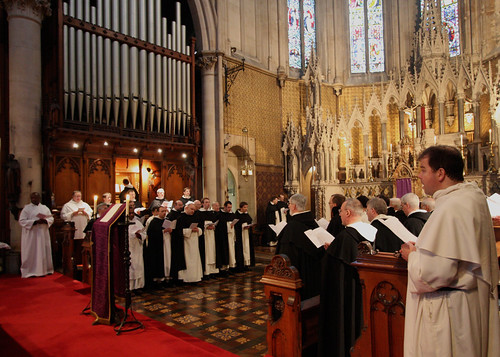
I am...uh...'borrowing' this beautiful picture from Dr Taylor Marshall's blog Canterbury Tales to talk about the Divine Office today. This post was particularly inspired by the blog Medical Matins, which is a must read for all Medics! For all my busy Medic friends, I have written this post, especially with you in mind. I hope you will at least read through most of it!
I love the Divine Office, after Mass, it is the next thing that keeps me sane every day. Daily Mass thought me how to centre my life around Christ. Because of the fixed time of Mass, it really requires to plan your day around it, in a sense it becomes the centre of your life. Going to meet friends in town? Mass is at half past six, either meet before or after Mass. The Divine Office pushed that to a new level for me. They say you get the most graces when you say the hours in the times when they are supposed to be said (Thankfully, you can anticipate matins!). Thus, when you completely settle the entire day around praying, it is really special.
I cannot explain it, but you really get a lot of graces from praying the Office. For those who are unfamiliar with the Office, it is essential praying the entire set of Psalms. In the extraordinary form of the office (EF), you pray all 150 in a week, in the ordinary form of the office (OF), you pray 143 psalms across the span of a month. As you all know, I am your typical Catholic, I have never read the bible from cover to cover, and I would have never dreamed of reading all the psalms, let me repeat, all the ONE HUNDRED AND FIFTY psalms. Yea, well, only through the grace of almighty God, I read it and continue to so every week.
And not only that, Matins, which consists of 9 psalms arranged into three nocturnes with accompanying lessons means that if God willingly, this time time next year, I'd have read through most of the bible as well! Well, not in it's entirety, as they do skip verses, but it's amazing! Right now, I am reading through the soap opera of King David's life in the second book of Samuel. He's just done nasty things with Bethsheba and Prophet Nathan is banging on his door. You'll have to read the rest yourself, it's all very fiesty ;)
Back to the point, you really do get a lot of graces. God likes to give out graces to people who want to pray more. Having difficulty with your daily prayer, like me? He will shower you with strength. It seems long, but each just Office just flies by. Not to mention how much it keeps temptation at bay.
For the Medic on the go, especially clinicals or doctors working, especially those who can't get to daily Mass, or find it hard to seek prayer during the day, or if you just need an escape into God's wonderful arms, the Office is the way to go. The various hours of the day punctuate the time, and will give you the strength to go on. Not to mention, the little hours are short, about 5 mins a piece. You can sneak them into your day at appropriate intervals. They are a booster of grace, if you will.
I said the Office only in the second semester of school, and it helped me to carry on during the long hours of study. You have no idea how many times through the day, when one stumbles upon an encouraging line, like psalm 56, 'Have mercy on me O God, have mercy on me, for upon You my soul has relied, /And in the shadow of Your wings I will trust, until the wickness passes by.' Not to mention all the lovely psalms of praise, like psalm 116, 'Praise the Lord all ye nations, etc'. Even if you can only find time to say compline, you will benefit greatly!
While it is only a devotion for us, the Divine Office is an obligation for all priests, and it sustains them. Here's a remark from a damned priest on the power of the divine office:
As far as I was concerned, I used to remember that I was a priest and, at the beginning, I used to exercise my Priesthood responsibly. And then, as time went by, I found that monotonous and, forgetting prayer, I also forgot about celibacy. I cut out prayer, firstly because I believed I was too busy, and then I used to take it up again occasionally, and then, finally, I abandoned it altogether. I used to think that those long prayers in the breviary were tedious and useless and, in the end, I lost the taste for prayer.
When I cut out the breviary, I fell into the sin of impurity, and from that moment on, I had no more taste for saying the Mass. This was a chain reaction. When I fell into impurity this was the chain reaction - I no longer said the Mass devoutly because I was no longer in the state of grace. In this condition, the reading of the Bible and of the Gospel, in particular, and also the sight of God's commandments, became a reproach to me.
The above from the a transcript of the damned priest, Verdi-Garandieu, whom God allowed to speak during an exorcism to a give a warning of damnation. So, it's got a stamp of approval from a damned soul. I suppose that's not much in terms of accreditation, but the Saints also have much to say as well. See St Alphonsus of Liguori:
On the other hand, when one recites the Office with attention, what merit and what profit does one derive from it. What lights are then obtained from the divine words! With what holy maxims is the soul penetrated! How many acts of love, of confidence, of humility, of contrition, may one not make by merely paying attention to the verses that one recites! Above all, what beautiful prayers are found in each psalm! There is no doubt that, when recited with faith and fervor, they merit treasures of grace, according to the infallible promise made by our Lord that he would hear whoever prays to him : Ask, and it shall be given you.(Matt. 8:7) For every one that asketh, receiveth.(Luke 9:10)My Affair with the Office
I first got started in the Office way back in 2009 when I bought an anglican breviary it was a translation of the 1955 Roman Breviary, so it was the EF office. During those days of tepid faith, I started clumsily with Compline. I loved it, especially the hymn, Te Lucis Ante Terminum, but unfortunately, a lack of mental stamina prevented me from overcoming the ribbon flipping and mountain of instructions. After a while, the saying of compline dropped out of my prayer routine.
It was only this year actually, after finding out all my friends were actually saying the office and so I thought, you know I'd better succumb to peer pressure like a good peer-pressure succumbing youth and jump on the bandwagon. I had, for sometime now, an app on my Ipod Touch, called Breviarum Meum, which allowed you to download the text of the EF Office into your phone for the week, which had both the Office in Latin and English.
See the none of this would have happened if I hadn't gotten into the habit of sleeping early and waking up at 3am to study. I just get more work done in the morning before heading off for morning Mass. I used to joke that me getting up so early was practice for saying Matins, which are usually sung at 4am in monastic communities. Unfortunately, God took too me seriously. I had originally started with Lauds, Vespers and Compline, each about 12 mins, and then I eventually, I felt that I had to add the little hours, Prime, Terce, Sext and None. The little hours are actually very short, and take about 5 mins each, with the exception of Prime (8 mins).
Before I knew it, I was toying with the idea of Matins...and BLAM! I'm waking up daily at 3am saying Matins every day at 4. And I loved it. Matins on normal days takes about 20 minutes to say, and on days with 3 nocturnes takes about 35 minutes. See what happens when you even joke about praying more?
All in all, if you're trying to squeeze in an hour of prayer a day, the Office is the way to go. It comes in delightful bite sized pieces. The aforementioned Dr Marshall has a really lovely piece on praying the Office. Read it here: http://cantuar.blogspot.sg/2010/12/how-to-pray-divine-office-in-latin.html. It is by far, the best article I have read on it yet.
I've also never actually said the Office in the OF, also called the Liturgy of the Hours, before. I started with EF by coincidence and have just start with it. If you want to know more about the differences between the two, read the comments in the above link on Dr Marshall's blog. All I can say, having looked at the OF Office, is that is is a kind of Divine Office lite, though they have more readings of the church Fathers. Try out the online versions and see which one you like.
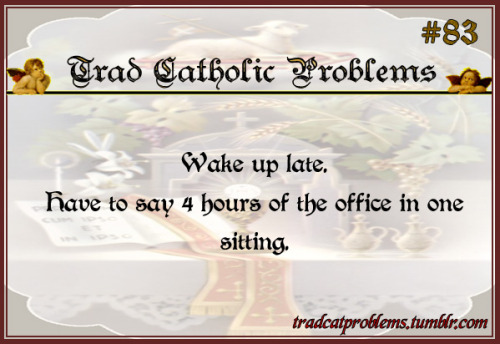
Anyway, don't let all this waking at 4am be an obstacle to your recitation of the office. I am a weird person after all. Now, that I am on holiday and am no longer waking up at 4am to pray Matins (which I miss doing), but I just start praying the Office in chronological order whenever I get up, which is between 10 and 1. I am a slob, I know. I also used to be very scrupulous about not missing an hour within the proper time frame, it was a great fear actually. Thankfully, after chillin' with some deacons from the Fraternity, they taught me that you can just say the hours as time permits within the span of 24 hours. We were touring Dublin on foot, and they pretty much wiped out their breviaries whenever time permitted. Also, remember that as lay people, we are not obliged to say the breviary.
| I really hate when that happens, because of my short stamina for prayer. |
Getting Started
My advice is to pray to God and ask Him for the grace to say the office, and then start with Compline. It is the sweetest and easier office to say, because it is nearly the same every day. Then add Lauds and Vespers. Don't worry about saying Lauds before dawn, just try and say it in the morning. Soon you'll be doing that Pringle thing where you can't stop popping and you'll find yourself saying all the little hours. And you know how the story goes from there.
It helps to start with an electronic form of the Office, because it has all the parts laid out for you in the right order. I.E. not ribbon flipping and confusion. Over time as you get used to it, go out and buy a set of Breviaries. The OF Office, also called the Liturgy of the Hours, comes in a 4 Volume set or a 1 Volume book called Christian Prayer. You should be able to get that from your Church bookstore, you can also order them from amazon or www.divineoffice.org, which also has the hours in English daily. That is a useful way to start. If you want it in Latin: http://www.almudi.org/Portals/0/docs/Breviario/fuentes/breviario.html. If you like to try the EF Office, the hours are available online here: www.divinumofficium.com. Unfortunately there is only one Latin-English Breviary available now, and that is by Baronius Press: www.baroniuspress.com. However, that is a rather dear breviary, but it is worth the price for something will last you over a decade and will be used every day.
For iPhone apps (which I think are available on android too):
OF Liturgy of the Hours:
http://www.ibreviary.com/
EF Divine Office:
All the best, and drop me a note if you have any questions or if all goes well for you!
If Confirmation Class was Boot Camp.
ATTEN-HUT!
GOOD MORNING MAGGOTS!
I am Sergeant Mercurius O'Brien, and for the next few months, I am going to prepare you for confirmation.
Dooo-ooo YOU know what that is son? Confirmation, huh? I CAN'T HEAAAR YOU. That's right son, it's a sacrament. Anyone want to give a guest what a sacrament is? Nope? Not one? What are they teaching you in your catechism classes?
Right, now listen up. Confirmation is a sac-ra-ment. It is outward sign of inward grace, and in this particular sacrament, you, yes you baby face, you are going to be sealed with the Holy Spirit. Does anyone know why? No one?
*aside* Oh good Saints in heaven, we have plenty of work on our hands.
YOU are the CHURCH MILITANT. You are being prepared for SPIRITUAL WAR. Yes, son, SPI-RI-TUAL WAR. Didn't your teachers tell you that in class? That ongoing right now is a great war between them angels up above, and those devils down below? A war between heaven and earth for the our very souls?!
Yes, that's right Jones, a war. for. your. soul.
Now listen up, from this moment forward, YOU, are going to forget every single nambly-pambly thing that you have been told by your catechism teachers. This is a war, and when you die. YES, you will die eventually, but don't worry, Our Lord, Jesus Christ has already conquered death, you won't have to be afraid. But, when you die, there will be four last things that happen to you. You will. 1) die. 2) be Judged, 3) go to heaven, or 4) go to hell. Have I made myself clear? Good.
What's that, Verrelli? Your teacher doesn't believe in hell? She said you God will take everyone to heaven? WRONG. What's that? Speak up Verrelli! It isn't in the bible? Have you read it? Well you better get started. Now drop and give me three decades! YOU CALL THAT A DECADE? Why, my grandmother, God bless her soul, could say a decade better than you. God bless her soul, could say a decade better than you. Why, she was a saint, she could pray better than the entire camp put together! Forty hours of exposition, she was there, all forty hours. On her knees. That's right her knees. On your feet, dirtbag.
Right, listen up maggots, you will, I repeat, you will go to hell if you live a life in a state of sin and a life contrary to the teachings of Holy Mother Church. If you support unnatural forms of marriage, or like to kill unborn children or not go for frequent confession. Do you have a problem with that son? Yes, you! The one in the tight pink shirt with the rainbow on it? Judgemental? Why.... clearly you haven't read the CATECHISM OF THE CATHOLIC CHURCH. Lemme give you some advice son. You have one and only one soul, and there is only one way to heaven, God's way. Better decide what you want, His way, or the highway.
I've never seen a more sorry bunch of fools in my life. Well, don't worry, we will teach you. Yes, we will teach you everything that you need to know to fight the good fight. We will arm you against the devil. We will teach you how to fast, and to do penance and mortify yourself. Here, you will learn to grab the cross when you are in trouble. You will learn to assist in the Holy Sacrifice of the Mass. You will learn the teachings of Holy Mother Church as she kept them for two thousand years. You are here so we can turn you into a saint. IS THAT CLEAR?
Alright, I think you have too much energy. Let's go for a tour around camp. By tour, I mean run. After that you will turn in and polish your shoes for Mass.
Let's go, let's go, let's go. MOVE IT!
I DON'T KNOW WHAT YOU'VE BEEN TOLD,
THE CATH'LIC CHURCH IS BRAVE AND BOLD....
Monday, July 09, 2012
St Augustine Zhao Rong (and companions)
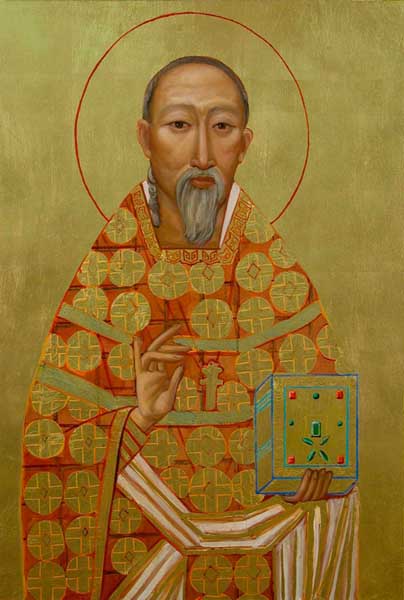
Today is the Feast of St Augustine Zhao Rong and companions, his companions being the many chinese catholics and catholics in China who were martyred since the 17th Century. He's a Chinese saint, so he, and you, get a special blogpost today! Yay!
Well, to tell you the truth, I also learnt the most about St Augustine Zhao Rong today during Mass, because the priest sadly decided to give a homily about him before Mass. I wonder why priests feel obliged only to do exegesis of the readings of the day during their homily in Mass? But, I think that will forever remain a mystery. Anyway!
Anyway, St Augustine ZR was a chinese soldier who lived in the 19th Century. Before being baptised he watched the martyrdom of Bishop St John Gabriel Taurin Dufresse, MEP, and later was ordained to the priesthood.
Soon after, he was arrested as well, and suffered the most grievous tortures before giving up his soul and receiving his crown of martyrdom in 1815.
The Church in China has been persecuted since it began, and that persecution goes on even now, especially with the Chinese government controlling the church and ordaining her own bishops. There is a underground movement in China, and to part of that movement loyal to Holy Mother Church doesn't bode well for those caught by the government. Pray for the Church in China!
Also, read more about St Augustine ZR's companions in this Catholic Culture article: http://www.catholicculture.org/culture/library/view.cfm?recnum=3159
Well, to tell you the truth, I also learnt the most about St Augustine Zhao Rong today during Mass, because the priest sadly decided to give a homily about him before Mass. I wonder why priests feel obliged only to do exegesis of the readings of the day during their homily in Mass? But, I think that will forever remain a mystery. Anyway!
Anyway, St Augustine ZR was a chinese soldier who lived in the 19th Century. Before being baptised he watched the martyrdom of Bishop St John Gabriel Taurin Dufresse, MEP, and later was ordained to the priesthood.
Soon after, he was arrested as well, and suffered the most grievous tortures before giving up his soul and receiving his crown of martyrdom in 1815.
The Church in China has been persecuted since it began, and that persecution goes on even now, especially with the Chinese government controlling the church and ordaining her own bishops. There is a underground movement in China, and to part of that movement loyal to Holy Mother Church doesn't bode well for those caught by the government. Pray for the Church in China!
Also, read more about St Augustine ZR's companions in this Catholic Culture article: http://www.catholicculture.org/culture/library/view.cfm?recnum=3159
Some thoughts on prayer.
Many people eschew prayer because it is a very difficult thing to do. One often has to force oneself to do it. Yes, it is true, that one does desire to do it, but at times, it certainly does feel like a chore before one starts. And then when you start, it seems to drag on forever, especially when one does a Holy Hour or starts reading Matins on days of first class feasts or even one starts the saying a rosary. I would bet that most Catholics, being the lukewarm king, would probably find that praying more than just the three necessary prayers (the Our Father, Hail Mary and Glory be.) would be an agony. I think Dr Peter Kreeft talks about this in one of his talks, though I can't find the one right now, but he concludes that it is necessary for believe that prayer be difficult, otherwise everyone get complacent.
But you know what, I welcome that feeling of prayer lasting forever. I want my conversation with God to last an eternity, I just want to spend all my time with Him. I know that I cannot do that now because I am so attached to the material things of this world and that my heart is still attached to sin. The pain from this timeless striving for concentrating and continual focus is from these attachments, because one cannot be in the presence of the infinite God with stain of sin. One will burn, and that is why in death, should we be fortunate enough to attain heaven by God's great mercy, we go through purgatory to remove all the sin remaining in souls. I pray that He will cut asunder all those horrid bonds of unnecessary things and that my heart will become completely open to Him. And only then, when He can finally come into my heart, and close the door behind will I be able to experience Him without the chains of temporality. Then, I made silent, and listen completely to His sweet words.
That is what the mystics experienced, they opened their hearts so completely to Our Lord, that He was able to dwell completely in their hearts, and they completely set apart from the world, were in a completely connexion with God. I think about St Dominic Slavio, going into his first ecstasy, not realising the hours that had passed by, until St John Bosco tapped him gently on the shoulder. I remember what one very holy priest said about another mystic, St Bernardino of Siena,
'And we don't know to what extent he saint, because Brother Vincent who travelled with him on the same donkey, died just before him, and he was not allowed to say what he knew, because he was always in intimate union with God and often in ecstasy! That is the correct dynamic! God having access to the heart!'
Until my heart can truly commune with my Lord, I shall at least take some consolation in the short glimpse of eternity with my sweet Lord.
But you know what, I welcome that feeling of prayer lasting forever. I want my conversation with God to last an eternity, I just want to spend all my time with Him. I know that I cannot do that now because I am so attached to the material things of this world and that my heart is still attached to sin. The pain from this timeless striving for concentrating and continual focus is from these attachments, because one cannot be in the presence of the infinite God with stain of sin. One will burn, and that is why in death, should we be fortunate enough to attain heaven by God's great mercy, we go through purgatory to remove all the sin remaining in souls. I pray that He will cut asunder all those horrid bonds of unnecessary things and that my heart will become completely open to Him. And only then, when He can finally come into my heart, and close the door behind will I be able to experience Him without the chains of temporality. Then, I made silent, and listen completely to His sweet words.
That is what the mystics experienced, they opened their hearts so completely to Our Lord, that He was able to dwell completely in their hearts, and they completely set apart from the world, were in a completely connexion with God. I think about St Dominic Slavio, going into his first ecstasy, not realising the hours that had passed by, until St John Bosco tapped him gently on the shoulder. I remember what one very holy priest said about another mystic, St Bernardino of Siena,
'And we don't know to what extent he saint, because Brother Vincent who travelled with him on the same donkey, died just before him, and he was not allowed to say what he knew, because he was always in intimate union with God and often in ecstasy! That is the correct dynamic! God having access to the heart!'
Until my heart can truly commune with my Lord, I shall at least take some consolation in the short glimpse of eternity with my sweet Lord.
Marriage and Vocations Part II
Part
II
In my last post, I wrote about the lack of
understanding and following one’s vocation as one of the reasons for the
decline of marriage. To continue on that train of thought, there are separate
problems stop Catholic youth in Singapore from seriously considering Marriage
as a vocation.
Feminist
Mentality
The fallout of the revolutions left many
scars in the world, the feminist revolution left us the feminist mentality. I
find that the majority of my friends who come from good all girls schools in
Singapore, especially one somewhere in central Singapore, tend to be groomed in
it. The alien called feminism which grew up in the 60s has crawled and clawed
its way into heads of many teachers who go onto fill all these girls with
thoughts of all sorts of career-driven independence and girl power.
![]() |
| Feminism and the Feminist mentality |
Now, if you are asking why I would write
something so hateful and sexist, then you must put down your pitchfolks and
lawyers and left me explain. See, all Feminism holds its roots in Marxism, see http://www.crisismagazine.com/2012/is-feminism-a-heresy.
So therefore, at the heart (essence) of all Feminism is Socialism, and at the
heart (essence) of Socialism is a atheistic utilitarian state. Socialism thinks
that religion is all stupid and that no one takes their religion seriously.
It’s all a joke to them.
Utilitarianism is a philosophy that can be
summarised as ‘what ever the means for the greatest pleasure’. At the state
level, the greatest ‘pleasure’ is material wealth, i.e. the greatest profit.
Therefore, in order to reap the greatest profit, more people need to be added
to the workforce, i.e. women. So, at the heart of feminism is this need to make
profits for the state, hence the career driven philosophy of feminists.
While, people who have a feminist mentality
are not themselves feminist, they still have this prevailing attitude, since it
is essential to feminism. So girls, if you think that getting married at
thirty, after establishing your career and rolling around in your bathtubs of
greenbacks and ‘living the life’. Congratulations, you’ve just been oppressed
by Fredreich Engels and Karl Marx, two men.
Having
the Cake and Eating It
Another problem that arises from the
prevailing feminist mentality is that often these girls are no longer taught to
be feminine. This great independence that they are empowered with will be their
end. After all, being too independent doesn’t allow one the charity to be
served by others. My friend was recounting to me the other day of how when she
first went to a co-ed school, she had a bit of a culture shock when boys
offered to carry her things for her.
This of course, stems from the feminist
(and of course from the Marxist) idea of egalitarianism, that all Men are equal
in all attributes and abilities. This is of course sold to people in the
oversimplified form of, ‘all men are equal, and therefore should have equal
rights’.
Heh, that reminds of the time I was having
dinner with this group of friends and this really pretty girl that I had a huge
crush on at that time. She is a lovely girl and she hailed from one of those
schools. Anyway, of course I made the mistake of telling my favourite
anti-feminist joke that I like to tease the girls with. It goes something like:
‘All the great wars were caused by women.’
[Vexed look] ‘But, but, what about the
world wars?!Or, the ware to tease the
girls withlen of Troy, all these started because of a competion and she hailed from one of those scho’
‘They weren’t great. Entire peoples were
not eradicated.’
‘So what’s great then?’
‘Think about it. The Trojan War? Complete
eradication of Troy by the Greeks, over who? Helen of Troy, all these started
because of a completion by Artemis, Hera and Aphrodite.’
‘But that’s mythical!’
‘Or, what about that time Genghis Khan
wiped out the Merkits for kidnapping his wife?’
Well, of course the point is, in a bit of
teasing jocular manner, that men start wars over women because women are worth
fighting for. Now, that I’ve ruined a perfectly good joke(well, at least I
think it’s funny) by explaining it. I always get two reactions: the girls who
are authentically feminine get the point immediately and tease back or smirk to
themselves or the girls get all riled up and reactionary. I can’t say I don’t
enjoy both reactions.
Well, okay I didn’t that night. She was
sitting across me and when I started, my friend interjected and said, ‘You
better not say that in front of B----‘, and I looked up to find to a black
stare. Whoops. ):
But that brings me to my next point.
Authentic
Feminity vs Feminism
The truth is that men and women have never
had equal rights in the past, feminists got that part right. Men have always
given women much more rights. The right to have doors opened for them, hats
doffed in the presence, to carry their things, and buy them dinners and all
sorts of other ceremonies. Men didn’t do this out of obligation, they did it
out of love. They did it, not because the women couldn’t do it themselves, they
knew they could, but they did it because they wanted to do it.
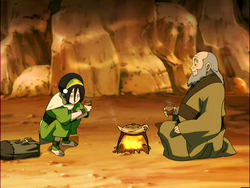
Think of that famous (if you watch cartoons)
dialogue between Toph and Uncle Iroh. Toph, the blind earthbender is
aggressively independent and refuses to be helped in anything. When Uncle Iroh
begins to pour tea for her, she objects, to which he replies, ‘You sound like
my nephew. Always thinking you need to do things on your own without anyone's
support. There is nothing wrong with letting people who love you, help you. Not
that I love you. I just met you.’
Such great wisdom from a 2D character. Of
course it is possible to love someone you just met or haven’t met, when you see
them through the lens of Christ.
The Church, the only great enemy and
obstacle to Socialism, and number one promoter of women’s rights, has always
understood that all persons are not equal in make, but equal in dignity. She
teaches that God made people different, some to suffer in poverty, who are
Christ’s special friends, because he denies them material attachments that they
might easily find their way home to Him, and other blessed with wealth, that
they may help the poor, and in their sacrifices, learn discipline and
detachment and find their way home to Him.
Likewise, in the beginning, God ‘made them
male and female.’ He made them different, with different characteristics and
abilities, but equal in dignity. Remember the path to Heaven is the way of the
cross, it is a denying of oneself for God’s will. He asked that women sacrifice
their pride, in order that man be chivalrous, and to submit to their husbands,
but He also mandated that husbands should love their wives as Christ loves His
Church.
At the heart of Feminism, though Marxism is
the Utilitarian principle, which is the greatest pleasure for the self. This is
a ‘me’ generation. On the other hand, to be authentically feminine is to be
centred around one’s vocation. That is to have Christ at centre of one’s heart.
That is the key difference between femininity and feminism. Feminism calls
women to be slaves to the state, making it money, and then indulge themselves
in material things, before anything else. Marriage, family and children are
commodities. Childrearing is seen as a ‘job’, one that does not bring any
material profits. (I had a friend who asked why women weren’t being compensated
for their national service). Christ calls women to be wives and mothers, to
take up the joy of the duty of motherhood. That is to part take in His divine
plan and to co-create with Him, little souls that may fill up Heaven.
Feminism seeks the benefit of one. Christ
seeks the benefit of all. Feminism
desires of society, rights, Christ desires love. Choose wisely.
Tomorrow: The boys aren’t off the hook
either! They are in a much worse state.
Sunday, July 08, 2012
Marriage and Vocations
A few months ago, I
was having dinner with a few catholic friends of mine of the same very old goat
age on the verge of 24. We sat, three guys and three girls, at the table, and
were talking about life. The conversation drifted onto the topic of family and
children. The conversation (to the best of my memory) when something like this:
'No, I don't want to
get married and have kids so early!'
'yea, me too'
'but, why not?' (me,
the only stupid one in the group)
'I want to live my
life! I don't want to settle down so young.'
It’s true, my friends
do deserve to live their life. They just finished slaving for a very long
degree and should have a chance too, or so we in the field lie to ourselves
once school is over. That said, this is the prevalent mentality amongst so many
of my young friends these days. If you compared this to life eighty years ago,
the young people then who couldn’t wait to get married and have kids would be
scandalized, and then they would layeth the smacketh-down as only a world war
one veteran layeth. And then it would hurt.
It seems as though
life is now all about just career and money and living my life first. So, this raises some hairy questions. Why don’t
Catholic girls (and boys) want to get married young? What is this life that
they want to live? And, how did that woman from the ‘30s knock you out with one
punch?
What is this life they want to live?
The hairy question is
really what this ‘life’ is and is it worth living? Is it the working life,
fraught with many hair-raising corporate tales, all the while sitting in a
cubicle? Nope.
Is it making more
money then you know what to do with it finally filling your bathtub with ten
dollar bills just so you can pretend you’re swimming in dough? Nope.
Is it jet setting
across the world, thus draining the metaphorical bathtub of all that
metaphorical dough? Well…still nope.
| Bathing in money will give you paper cuts and will make you feel icky. Try the Blood of Christ instead, washes away even the deepest hardest to reach sin. |
Sure, all these things
are great and you will be seemingly content for a short period of time until
you go back to your empty bathtub and return to your cubicle and have to start
writing patient discharge summaries again. Then you look in the mirror at that
old greyed figure, thinking about the drudgery of life and repeat the cycle,
jaded and empty and thinking about how you lost your childhood in the
university library.
Vocation
But there is help. You
see, there is only one life worth living, and that is the life that God has
planned for you. Every single one us has a vocation in life, and the journey’s
end is the same: REACH HEAVEN. That is the only thing that will make us happy,
to be with God in heaven, it is our destiny!
So huge an epiphany
was this that in writing his Confessions,
the doctor of the Church, St Augustine of Hippo wrote, ‘ for Thou hast formed us for Thyself, and our hearts are restless till they find rest in Thee?'
Like that fluffy new-age analogy, there is
a ‘God-shaped’ hole in your heart that only God can fill. To take that a
Catholic step further, and it will only be completely filled in heaven, but
until then, the Lord in His omniscience and great mercy decided to that He
would give us respite from this insatiable loneliness that can only be filled
by Himself by giving us the religious life and Holy Matrimony. Some very
privileged souls are called to the religious life.
The majority of us are called to be married
and then help God to make more souls and populate heaven! How much more
exciting can that get!? Like OH MY BRONTOSAURUS, do you mean almighty God lets
me, poor, wretched, sinful ME, partake in HIS creation of a new soul?! You
should be excited too. Stop rolling your eyes at the screen. Let me explain.
Yes, yes, I know, it’s big news and you’re
wondering, does this guy even know what he’s talking about?! Hello! Earth to
David, babies are hard work, they whine, and poop, and cry and puke all over
the place, then live with you for 18 to 25 years (depending on the culture) and
spend the latter of half that trying to exclude you from their lives, while
still siphoning precious greenbacks from your wallet. How is that supposed to
make you happy?!
Let me explain.
| That doesn't look so hard to raise. |
True
Living.
If, you believe that 1)we are all put into
this world by God to return to God, 2) and that God has a divine plan for us,
3) and that God is all and only good and wants therefore the best for us, then
you can only draw the conclusion that to live according to God’s given plan
will bring us the most joy.
Christ has already promised, ‘My yoke is
sweet and my burden easy’ (Matt 11:30). And what more can this very yoke be for
each of us, but our very vocations? We can be sure that work will have to be
done, and while dragging the plough, we will suffer from pain and
inconvenience, but Christ right there next to us helping us. He drags us bit by
bit to heaven. But, He can only do so if we have taken up His yoke, and
together with Him, we pull the plough.
Therefore, the faster that one fully
recognises what one’s vocation is, and works toward fulfilling it, then one
will truly find true joy with all of life. Thus St Laurence while on the grill
can quip to his executors, ‘this side is done, turn me over’ and Mother Teresa
can live in abject poverty looking after the poor.
Therefore, if it was planned that you live
in a house of screaming children, so that you may lead all of their beautiful
little souls into heaven, as a means of sanctifying yourself, then you will be
happy. I jest obviously, it’s not always a house of screaming kids, sometimes
the house is silent because it’s on fire and the screaming is outside, mostly
from the fire department. I’m really not sure how to explain this to you, so
just listen to what Jennifer Fulwiler has to say about career versus children: http://youtu.be/SNX0szzmekA?t=25m57s
Trust me, ask any mother or father whether it was worth having children and they will tell you, 'yes'.
The truth is, the path to eternal happiness
is the cross. It is about suffering, and suffering isn’t a bad thing. God lets
us suffer, so we are not longer attached to this world. In a weak narcissistic
age like us, that means to facebook, twitter, camwhoring, and technology. When
we no longer want the things of this world, we will want the things of heaven.
![]() |
| The Path to Heaven |
Friday, June 29, 2012
Wednesday, June 27, 2012
Head knowledge? Heart Knowledge? Huh????
‘I don’t know how to define that… is that
where you get all the virtues like compassion, and charity?’
‘It’s the subjective experience right?
Emotions and opinions that we have on God?’
Scarily enough, these are some of the
answers that I got when I asked youth to define the term, ‘heart knowledge’.
Head knowledge and heart knowledge are
favourite terms of catechists and adults in charge of formation and the like. I
always hear them getting thrown around. You know, ‘David, you have too much
head knowledge. You need to learn more heart knowledge!’? Well, actually, no, I
don’t know. These terms have actually caused me much angst for a very long time
now, because, 1) they are extremely vague and ambiguous terms, so I have spent
quite some time trying to figure what they mean, and 2) growing up as an
impulsive nerdy teenager, I obviously read a lot and acquired a lot of ‘head
knowledge’.
As a confused youth, I went through several
phases where I was confused about the terms and just nodded to trying
unsuccessfully to ditch ‘head knowledge’, to trying unsuccessfully to ditch
‘heart knowledge’ in a reactionary manner, to finally finding peace after
dropping the concept totally for one with clearer and well defined terms. It
should be interesting to note that, as someone who has read books and extracts
of Catholic teaching fairly decently across the history of the Holy Mother
Church’s two thousand history, such terms where never employed until the last
fifty years, and then, mostly in evangelical protestant circles. They’re
essentially new age fluff as my theologian/teacher mentor calls it.
![]() |
| It tastes good, it sound good, but no one is sure about what it is. |
Ambiguity
The ambiguity of terms is a great cause for
concern and as a pseudophilosopher and student of science, I do not like
ambiguous terms at all. While, head knowledge is easy enough to define, and is 'limited' to the theoretical knowledge or reason that one attains through reading
and so on, often these are concrete concepts like ‘Jesus Christ was crucified
for our sins.’, however, ‘heart knowledge’ is much more difficult to define. It
is anything from between, ‘practical experience’ to ‘feelings and emotions’ to ‘subjective
opinions’, but exclude what is head knowledge (after all, they cannot be the
same in order for a distinction to occur).
Now, each of these three things are very
different and shouldn’t lie under the same umbrella. ‘Subjective opinion’ is
something not unique to ‘heart knowledge’ since it will exist in the realm of
theory as well, thus the terms will overlap, and remain ambiguous.
Next, ‘feelings and emotions’ are not a
good foundation for the faith at all; the church fathers warn that emotions are
fickle and easily manipulated. For example, when we are in the presence of the
Blessed Sacrament, we should not expect to feel anything at all, because the
transubstantiation happens at a level beyond our sensory ability to perceive.
What we look at, smells, tastes, looks and feels exactly like ordinary bread
and wine. Yes, we often feel a supernatural sense of peace in His presence
under the veil of a sacrament, but what happens if all that is taken away, and
we presented with the consecrated host that looks, tastes, feels and smells
like ordinary bread? Well, our mind intellectually reminds us that piece of
bread before is really the body, blood, soul and divinity of Christ hiding
under the appearance of bread. I can imagine several possibilities where one
will not feel this feeling at Mass, for example being in a state of anger or in
a state of distraction. Thus, if one’s foundation of faith is based on
feelings, it will surely fall like the house built on sand. (This is not to say
that there are not emotions involved in our spiritual life. That supernatural
sense of peace that signifies God’s presence is mystical experience, and a
great consolation, but should not be the bar for our faith. Neither does it not
mean that there is only one way to know things, only that not all ways of
knowing things are equal.)
Finally, we are left with ‘practical
experience’, which is only one that provides somewhat of a clear distinction
between knowledge from the Heart and from the Head. However, even here there lies
ambiguity. For example, say, I was meditating on a piece of scripture and was
then granted an epiphany of said passage by God, and felt his supernatural
peace as reassurance, now would that be head knowledge or heart knowledge? It
was certainly a theoretical and reasoned gain of knowledge yet, it was also a
practical experience. Furthermore, the seat of knowledge is the head in western
philosophy and the heart is the seat of emotion. It is from the west that we as
Catholics derive our philosophy. Thus, that is how society has come to view
these terms. No one says, ‘my head is filled with sorrow’ or ‘I have grasped
the theory of relativity in my heart.’ That certainly sounds odd.
Anti-intellectualism
To add to the problem, when heart knowledge
is used in juxtaposition to head knowledge, it is usually taken to mean all
three aforementioned definitions at once, with the further presumption that
intellect is limited to head knowledge. Yet, knowledge is function of the
intellect, in fact, to know something is also act of the intellect (and yes,
there is a difference between knowing and knowledge, whereby the former is a
spiritual/emotional perception of information and the latter an ownership of
information). Thus, I can know Christ in
my heart, but in order to do that, I must have knowledge of Him in my head.
However, this article is not meant to deal
with that epistemology, and I trying to make this as readable as possible, so
we’ll get back onto the real point, the separation and limitation of the
intellect to the ‘head knowledge’. Often, when these terms are used, they are
done so, while probably unwittingly, in an antagonistic fashion. At catechism
classes and retreats, I so often hear the teacher or retreat master say after a
very short and simple lecture, ‘Okay, I think that’s enough head knowledge,
let’s do activity X to use our heart to learn instead.’ or during planning
sessions, ‘that’s too much head knowledge, we don’t want to go too much in
depth, it will fly over their heads.’ Unfortunately, an unintended consequence
of keeping lessons ‘practical’ in such a manner is that the kids then go
through life with the idea and complacency that I don’t actually need to learn
about God, I’m just fine the way I am. Jason T. Adams, a high school theology
teacher, sums it up rather neatly, with my
emphasis:
In the religion
classes at Catholic schools, the academic breakdown and failing interest of the
students is caused by two factors. First, students have been conditioned to
think that faith and reason are opposed. Catechists have coined an expression
that reveals this: "When it comes to faith, I want to teach my students
heart knowledge instead of head knowledge." Contrary to this trite
philosophy, "head knowledge" (a grasp of the tenets of faith), and
"heart knowledge" (the application of understanding to concrete
practices) are not mutually exclusive; rather, they are mutually beneficial and
inextricably related.
The result of this false dichotomy is an attitude in
the students that religion is about feelings, not substance. Because their orientation is non-intellectual from the onset, they
are ill equipped to handle concepts that stretch their minds or call for mental
discipline. The content of faith becomes so subjective to the students that they
believe there are no such things as right or wrong answers to questions of
faith.
You can read the rest here.
Again, that is not to say that these teachers do it on purpose. I firmly
believe it is well intentioned and done as a means of maintaining interest or
not to ‘scare’ the kids off. Moreover, these terms and the conventional way
that they are used appear to my mind to be remnants of the great
anti-intellectual movement of the 1960s. Yes, yes, intellectualism and the
intellect are different things, but it is this general
I-don’t-want-to-use-my-brain attitude that has prevailed and created the
Generation Y and now Generation Z eras of mental laziness and apathy. I had a
dear young friend cheekily remark to me the other day, ‘don’t you ever get
bored talking about intelligent things? Talk about meaningless things, it’s
more fun.’ Personally, I feel this particular attitude is annoying thorn left
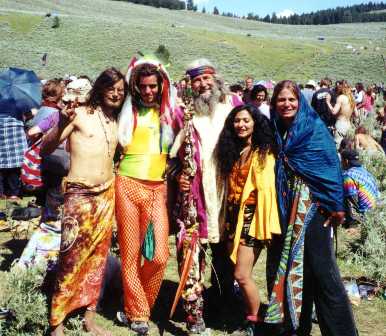
in society side, amongst other things, from the hippie revolution in the ‘60s.
| Hippism. Bringing the world back to the stone age since 1969. |
Another problem is that catechists don’t
give their teenage students enough credit. In school, by the age of fourteen,
they are learning abstract concepts like trigonometry or photosynthesis. These
things seem rather easy to understand, however try to recall when you were
fourteen trying to grasp the idea that light could be used to split water into
hydrogen ions and oxygen ions and the H+ ions were then used to
power the enzyme that made energy in the body. It probably took you a while,
but you learnt it nevertheless and passed your examination.
Theology is no different, it has terms
which seem foreign when first discovered, but the definitions are memorised and
churned about in the head until an understanding is formed. For example, the
idea of Transubstantiation. It essentially means that the substance or essence
of the bread and wine, that is their ‘breadness’ and ‘wineness’, the things
that make bread and wine, bread and wine, are changed into the substance of
Christ, while the accidentals, the smell, shape, colour, texture, etc caused by
this ‘breadness’ and ‘wineness’ remains. This is certainly not beyond the
average teenager to comprehend, though it will take a bit of time to reflect
upon.
However, all this is not to say that one
should throw the Summa Theologica at young rebellious teenagers. There are of
course different levels of understanding, and the appropriate level should be
taught, however the point is that what is taught should not be watered down and
diluted like a homeopathic therapy.
![]() |
Devotion
and Theological Thinking
A possible solution to the ambiguity of
head and heart knowledge is simple to drop the terms altogether for something
which is completely concrete and understandable at an instant.
Consider the third definition of head and
heart knowledge, which is the only useable one, that of theoretical and
practical application or experience of theology. Theology, very simply put,
asks the question of if God exists, and He could talk to us, what would He say?
In Christianity, God talked to us, He gave us the Word, and the Word was made
flesh and dwelt among us. So, what did this loving word say? In summary, God
loves you so much that he sent His only Son to die for your sins, now love Him
back with all your being and love your neighbour as yourself.
So how is this translated into theoretical
and practical knowledge? Theoretically, one has to have the knowledge that God
loves you; practically, one has to love God. Thus, to get the knowledge, one
must first learn it and reflect on it, this we call ‘Theological Thinking’.
This knowledge is then put into practice in an act of love towards God, simply
put, a ‘devotion.’
| The Rosary, both a devotion and contemplation. Archbishop Fulton Sheen calls it 19 minutes of perfect prayer. |
Recently, after a talk, my priest reminded
us that most people nowadays perform a great deal of devotion but they leave
out theological thinking. He said that the two of them go hand in hand and they
cannot be separated from each other and that absolutely everyone is capable of
some form of theological thinking.
This is certainly true, while not everyone
will reach the same depth of thought, it is more than possible to meditate or
contemplate on the word of God. That is why a church is usually filled with
statues, paintings and stained glass windows that depict saints and various
stories from their lives or from the bible. Together with the priest’s homily
every Sunday, the simple illiterate folk from olden times probably had a much
greater appreciation of theology than we do despite being unable to read.
Intellect
These acts of devotion and theological
thinking are in fact acts of the
intellect. Thus, in an ironic strict sense, ‘heart knowledge’ is ‘head
knowledge’. While knowing God can come through various means, the act of
devotion and theological thinking are both acts of intellect, because one must
will oneself to perform the action. Since they both stem from the intellect,
one cannot separate the practical from the theoretical, so to speak, and one
requires both of them together to nourish the intellect and gain a greater
knowledge of God. True to the both/and mentality of Catholicism, neglecting one
of these acts will result in a stumping of spiritual growth.
This is one of the reasons that the
Pentecostal Renewal movements that spring up megachurches have such high
attrition rates, they are all devotion without any real foundation. The same
can be said for the movements within the church which are influenced by it and
similar groups. ‘Head knowledge’ gives ‘heart knowledge’ its foundation.
However, with ‘head knowledge’ being
eschewed for ‘heart knowledge’ for the last fifty years, most will be found
wanting for even the most basic foundations of the faith to begin some
meditation. Which begs the question, over the last year, how many books on the
faith has one actually read? They don’t strictly have to be theology, but even
books about the lives of saints and spirituality, because if they are good
books, they will spring out from theology. Or even articles online, which are
very easy to find.
Yes, my friends, this very long article was
to inspire you to go pick up a nice good Catholic book. But seriously, the
words we use are important because of the concepts that they hold. You'll be doing what the Holy Father, and all his predecessors have been telling us, LEARN about the faith.

Subscribe to:
Posts (Atom)